






Termeh and Kashmir: The Shawl's Only Cousin
In the entire history of world textiles, exactly one tradition bears a family resemblance to the woven Kashmir shawl: the termeh of Iran. Everything else that looks like our craft is an imitation of it. The termeh alone is a relative, born of the same deep cultural exchange that shaped Kashmir itself, and the comparison between the two is the best lens there is for seeing what made Kashmir's achievement unique.
Two Valleys of One Civilisation
Kashmir's bond with Iran is old and profound. Islam came to the valley in the fourteenth century largely through Iranian missionaries; Kashmiri scholars studied in Iran's intellectual centres, and under the Mughals, whose court language was Persian, the connection only deepened. The very vocabulary of our craft tells the story: buta, jamawar, do-rukha, khat-rast, the words are Persian. From at least the mid sixteenth century, Iranian records name two recognised luxury cloths, shal-e-termeh and shal-e-Kashmir, the shawl of Iran and the shawl of Kashmir, distinguished but spoken of together. Iranians wore Kashmiri cloth their own way, not draped over the shoulders as in India but wound as turbans and folded as waist sashes, and the material was rank made visible: coarse cloth for the ordinary man, Kashmir material invariably for the noble. In wealthy households, shawl cloth was dowry and heirloom, and even worn fragments were cherished, recut into caps, purses, and covers.
The Same Technique, a Different Soul
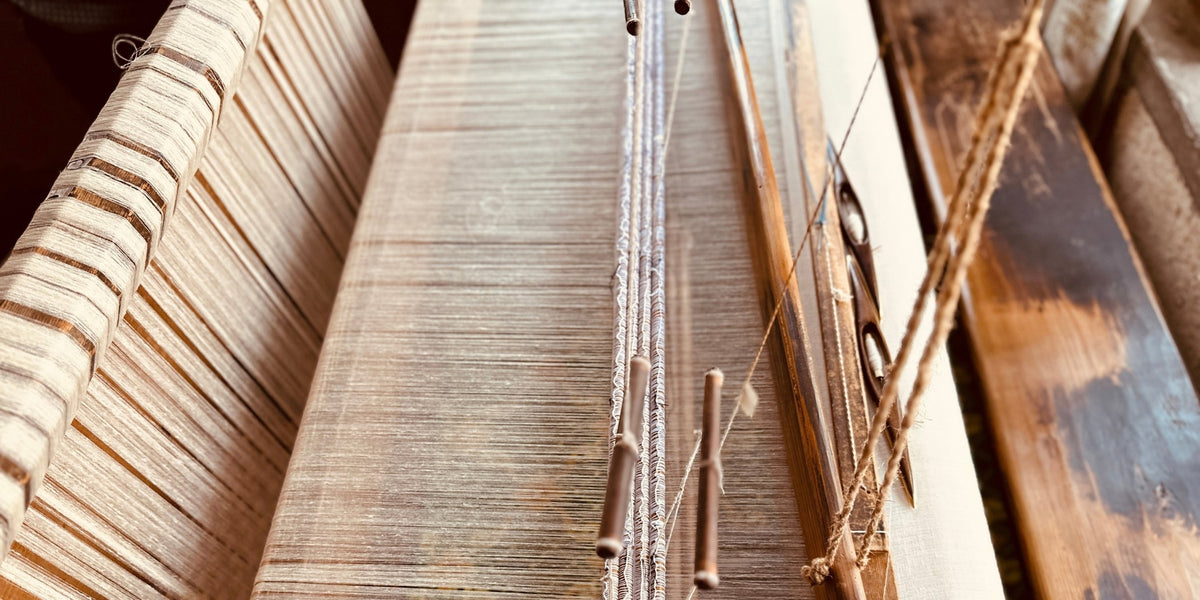
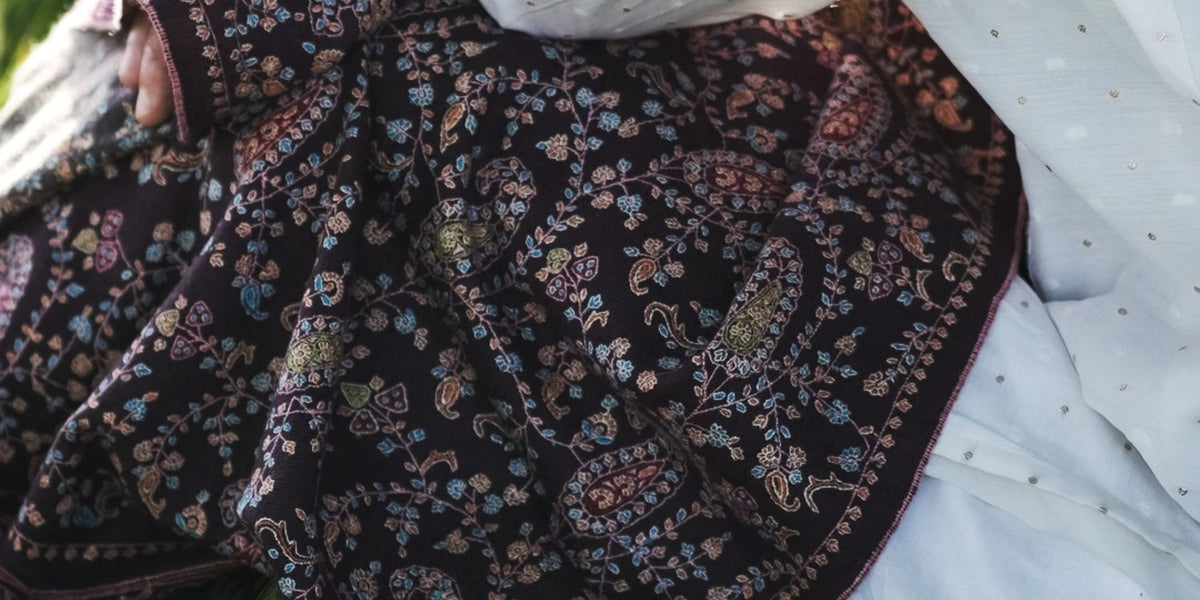
Termeh, woven chiefly at Kirman from kork, the down of Iran's own mountain goats, shares the Kashmir shawl's fundamental technique: twill tapestry, the pattern built as the very structure of the cloth. It shares the design vocabulary too, favouring buta repeats and khat-rast stripes so close to ours that experts still debate the origin of individual pieces. But the two traditions solved the central problem of complex weaving in opposite ways, and here the comparison turns revealing. Kashmir invented the talim, the written code that let designs of any scale and intricacy be recorded, transmitted, and woven exactly. The termeh workshops had no such system; their weavers, very often children, learned the patterns by rote, and scholars connect the generally smaller, more repetitive scale of termeh design directly to that absence. One tradition wrote its imagination down and so could grow it without limit. The other kept its imagination in living memory, and was bounded by what memory could hold.
Different Endings
The nineteenth century treated both crafts harshly, and their endings diverge as instructively as their methods. Iranian royal decrees repeatedly tried to favour the home product over the Kashmir import, and repeatedly failed: the elite preferred Kashmir. The Kirman workshops dwindled through the century, and when handloom termeh finally faded in the early twentieth century, its weavers moved into the region's booming carpet industry. Kashmir's Kani weaving also died commercially in the same era, but with one difference that decided everything: in Kashmir the knowledge was deliberately kept alive in weaving families through a century without a market, and so, when demand returned, Kashmir could revive. Of a comparable revival of the old termeh there is little prospect; what sells under the name today is largely jacquard woven imitation. Two cousins entered the twentieth century together. Only one walked out of it alive, and it is the one whose weavers refused to let go.
We honour the termeh as family. And we note, with a pride that we hope is earned rather than boastful, which branch of the family kept the flame.
Frequently Asked Questions
What is termeh?
Iran's traditional twill tapestry shawl cloth, woven chiefly at Kirman from kork, the down of Iranian mountain goats. It is the only textile tradition in the world genuinely related to the woven Kashmir shawl.
How is termeh different from the Kashmir shawl?
The fibre is Iranian kork rather than Ladakhi pashm, and the workshops used no talim: weavers learned patterns by rote, which limited design scale. The Kashmiri talim system allowed designs of unlimited complexity to be written and woven exactly.
Did Iran buy shawls from Kashmir?
In great quantity. Iran was one of the Kashmir shawl's largest historical markets, wearing the cloth as turbans, sashes, and tailored garments, and even royal attempts to promote the home product could not displace the Kashmiri import among the elite.
Why do Persian words appear throughout Kashmiri craft vocabulary?
Because of centuries of religious, scholarly, and courtly exchange between Iran and Kashmir, deepened under the Persian speaking Mughal empire. Terms like buta, jamawar, and khat-rast are shared inheritance.
Is handwoven termeh still made?
The handloom tradition faded in the early twentieth century and, unlike Kashmir's Kani weaving, was not preserved through the gap; modern termeh is mostly jacquard woven imitation.

Written by Veave Lore

Leave a comment
This site is protected by hCaptcha and the hCaptcha Privacy Policy and Terms of Service apply.