






The Language of Pashmina: A Collector's Glossary from Alwan to Zanjeer
Every old craft develops its own tongue, and Kashmir's shawl tradition, four centuries deep, speaks one of the richest. Knowing even a dozen of its words changes you from a shopper into a collector: you can read a product description precisely, ask a maker exact questions, and hear immediately whether the person selling to you truly knows the craft. Here is the working vocabulary, in simple English.
The working vocabulary
| Term | Meaning |
|---|---|
| Alwan | Plain, undecorated Pashmina cloth woven in twill. It is the canvas on which Sozni embroidery is worked and a classic shawl in its own right. |
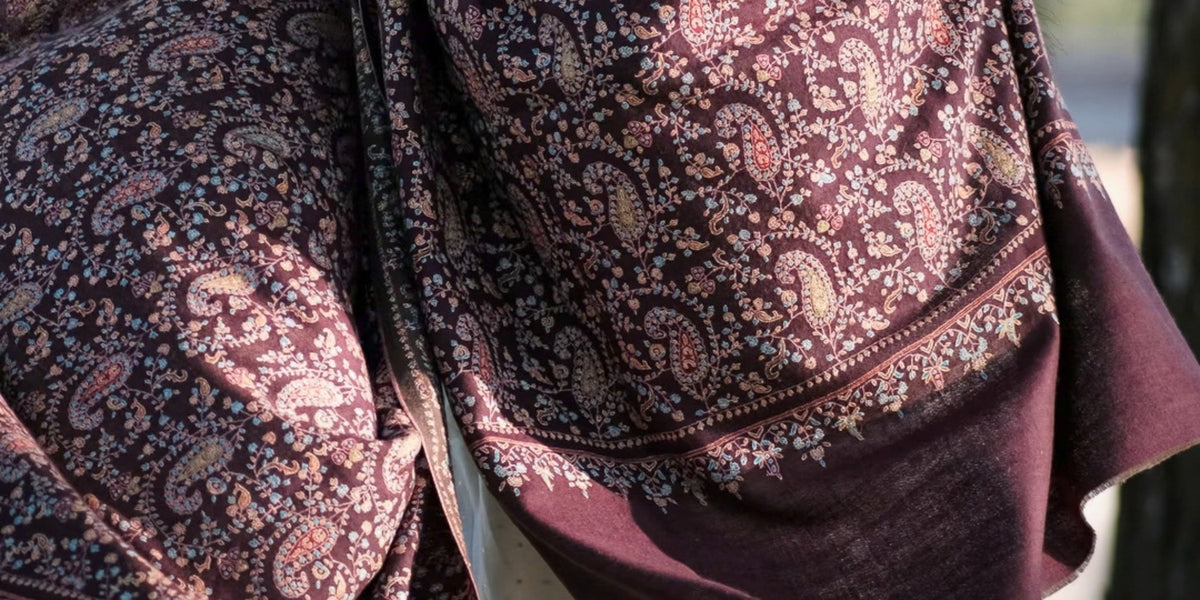
| Border | The framing bands of a shawl: the long bands down the sides and the horizontal bands enclosing the decorated end panels. The evolution of borders, from slender floral meanders to broad and opulent frames, is a key clue to a piece's period and register. |
| Buta | Kashmir's great motif: the bent-tipped floral cone known around the world as paisley. Its small cousin, a single flower repeated across a field, is the buti, while the intermediate size is often called a buta-buti. |
| Chand-dar | The moon layout of the square shawl: a central medallion with quarter medallions in the corners. |
| Changra | The herders' name for the Changthangi goat of Ladakh, the source of true pashm. The herders themselves are the Changpa, and their high plateau is Changthang. |
| Chashm-e-bulbul | The eye of the bulbul: a small lozenge-shaped twill variant used for fine plain weaves, named for the songbird's eye it resembles. |
| Do-rangi | Two-coloured: cloth woven with two ground colours. Not to be confused with do-rukha or do-runga. |
| Do-rukha | Two-faced: work finished so perfectly on both sides that the shawl has no wrong side. |
| Do-runga | Two colours, two faces: the summit of embroidery, in which the identical design appears on each face in a different colour scheme. |
| Doshala | Two shawls: the classic long shoulder mantle, so named because the finest pieces were woven in identical pairs to be stitched back to back. |
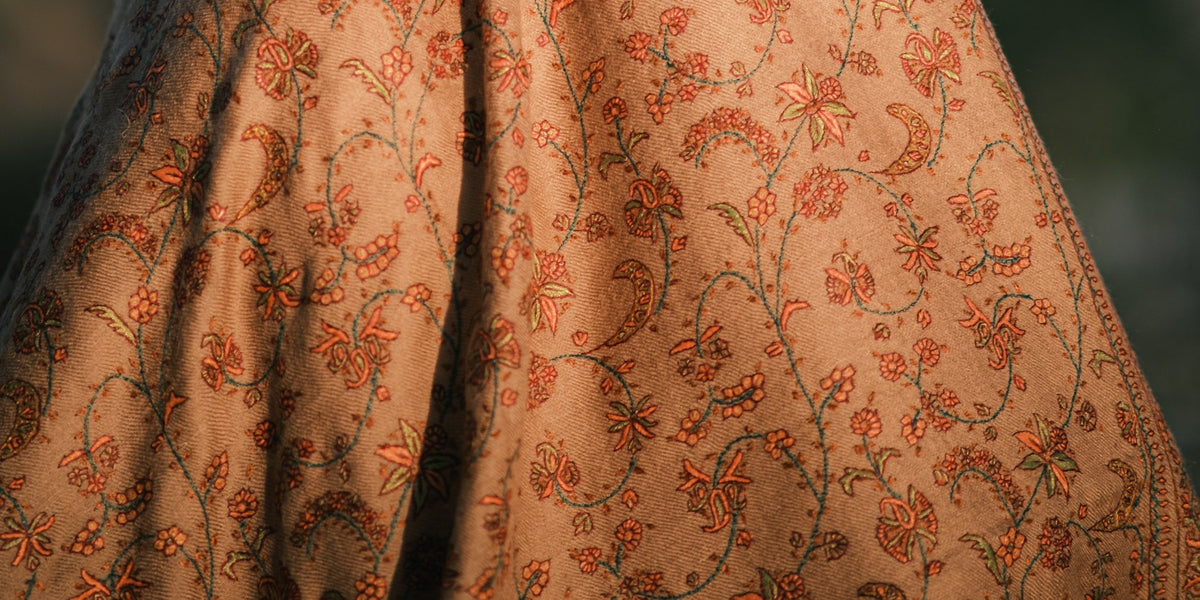
| Jaal (jaaldar) | Net, netted: an open trellis of embroidery spread across the field, lighter than full coverage. |
| Jamawar | Garment cloth: fabric patterned all over, edge to edge, without end panels. Historically tailored into robes, it is today the most formal class of shawl design. |
| Kani | The small eyeless wooden bobbin that carries each colour of weft in twill tapestry weaving. By extension, the term also refers to the technique and the shawls themselves. Also called tili or toji. |
| Khat-rast | The striped style: patterned bands of alternating colour running the length of the cloth, a signature of jamawar design. |
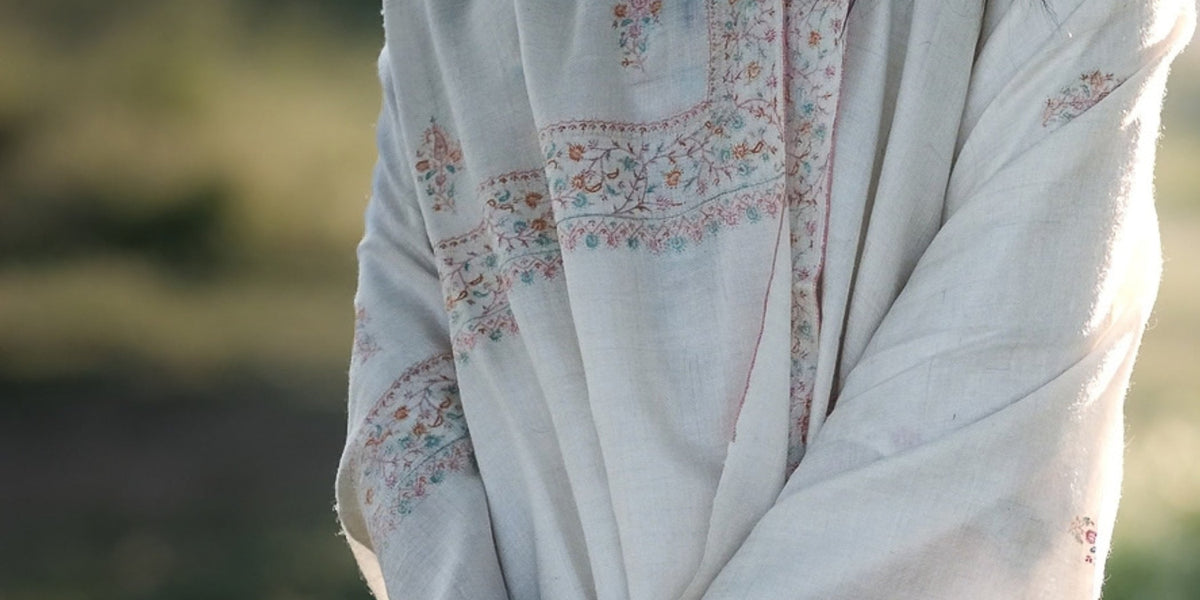
| Khudrang | Self-coloured: the natural, undyed fawns, greys, and browns of pashm, prized in their own right for centuries. |
| Naqash | The designer: the master draughtsman who creates shawl patterns freehand and the historical lynchpin of the entire craft. |
| Pashm | The raw spring down of the Changra goat. Pashmina is the yarn spun from it and the cloth woven from that yarn. |
| Rafugar | The darner: the needleworker whose invisible seams joined the panels of the great shawls and whose repair skills remain famous across India. |
| Rumal | The square shawl, historically worn folded on the diagonal. |
| Sozni | Kashmir's fine hand-embroidery tradition, built around a stitch that imitates the grain of woven cloth and a discipline that keeps the reverse clean. |
| Talim | The coded script unique to Kashmir that records a woven design line by line: how many warp threads to lift and which colour to insert. It preserves the complete working memory of the Kani craft on paper. |
| Twill | The weave of Pashmina: each weft goes over and under pairs of warps in a changing sequence, forming the fine diagonal rib that gives the fabric its characteristic drape. |
| Zanjeer | The thin horizontal borders enclosing the decorated end panels. The term is also used for the bordered blankets of Kashmir's villages, where the techniques of the shawl have deep local roots. |
Speak even a little of this language to a true maker and watch the conversation change. The craft opens to those who call things by their names.
Shop shawls for men and women at Veave Lore
FAQs
What is the difference between pashm and Pashmina?
Pashm is the raw combed down of the Changthangi goat. Pashmina is what Kashmiri hands make of it: the spun yarn and the woven cloth.
What does Kani mean on a product page?
That the design is woven into the structure of the cloth itself, bobbin by bobbin from a talim script, rather than embroidered or printed on. It signals the most labour intensive class of Kashmiri shawl.
What is the difference between jamawar and jaaldar?
Jamawar describes all over patterned cloth in the woven tradition and, by extension, the densest register of design. Jaaldar describes an open net of embroidery across the field, lighter in coverage.
What does khudrang mean?
Self coloured: the natural undyed shades of the fibre itself, from ivory through fawn to deep brown, valued for their depth and honesty since the earliest days of the craft.
Why does terminology matter when buying?
Because precise terms carry precise claims. A seller who uses do-rukha, Kani, or Sozni correctly is making verifiable statements about construction; vague language usually hides vague origins.

Written by Veave Lore

Leave a comment
This site is protected by hCaptcha and the hCaptcha Privacy Policy and Terms of Service apply.