






Seven Myths About Pashmina, Corrected
No luxury textile in the world trails more legend than the Kashmiri shawl. Some of the stories are charming, some are sales tricks, and some have done real harm. A house that has lived inside this craft since 1881 owes its clients the truth, so here are the seven myths we hear most often, each corrected against the documented record.
Myth one: the fibre is gathered from rocks and bushes
The most persistent tale of all: that goats rub off their winter down against mountain shrubs, and herders wander the slopes collecting the wisps. It is a lovely image and pure fiction. A craft that has clothed emperors for four centuries could never run on stray fluff. Pashm is combed from the living goat each spring by the Changpa herders, deliberately, gently, and in stages. The myth matters because it erases the herders themselves, the first and hardest working link in the chain.
Myth two: Pashmina comes from a rare wild animal
The Changthangi goat is raised, bred and looked after by nomadic families, and no animals are injured when their down is harvested. The source of confusion lies in another fibre with a darker history: toosh, the down of the wild Tibetan antelope, once used in the famous shahtoosh shawls of the old courts. Getting the toosh involved killing the animal, and demand in the late twentieth century drove the species towards extinction, so every aspect of that trade is now prohibited worldwide. Pashmina and shahtoosh come from completely different animals and are entirely different fibres, and only one of the two belongs in an honest wardrobe.
Myth three: the ring test proves authenticity
A genuine fine shawl can indeed be drawn through a ring, and dealers have demonstrated it for two centuries. But the test proves lightness and loose construction, nothing more. Fine blends and, in some cases, even synthetic fabrics can pass through the ring, while a thick, heavily embroidered pure Pashmina masterpiece cannot. Treat the ring as theatre, and judge the shawl by the origin of the fibre, the natural irregularities of hand spun yarn, the structure seen on the reverse, and the credibility of the maker.
Myth four: Pashmina and shawl weaving are the same everywhere
The term pashmina is used all over the world for any soft wrap, including machine woven products from factories that have never handled the fibre, and blends that include silk or synthetic materials. Historically, however, the term is very specific: it refers to yarn spun by hand from the undercoat of the Changthangi goat, and to cloth handwoven from that yarn in Kashmir. When the word is stretched to cover everything, the buyer should ask precisely what fibre, what spinning process, and what kind of loom is involved.
Myth five: the paisley is Persian, or a mango, or the tree of life
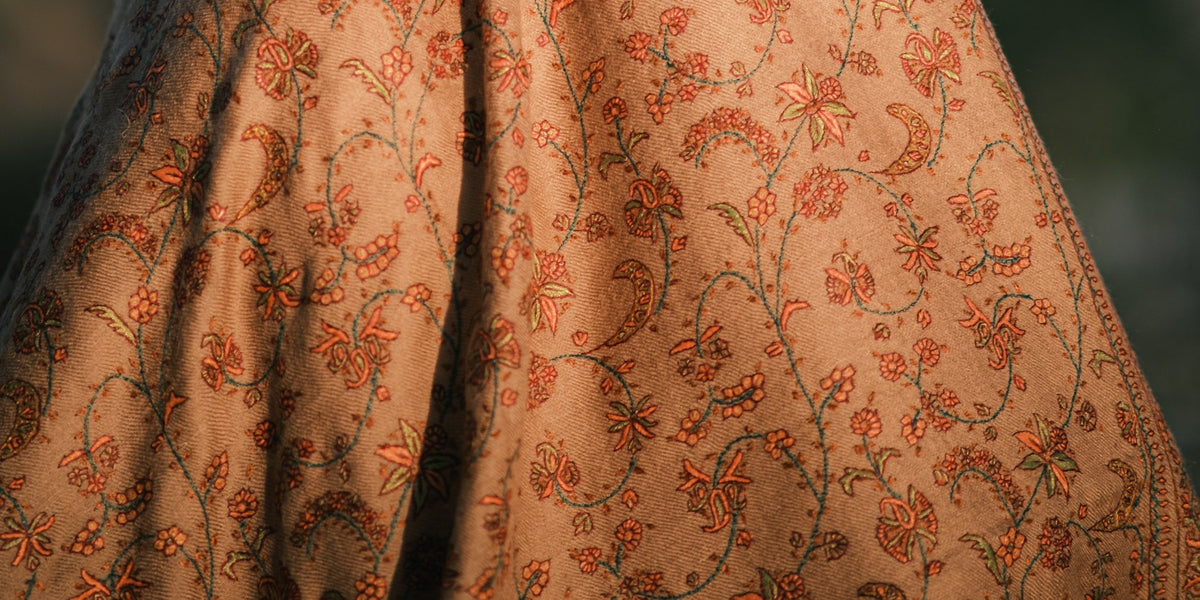
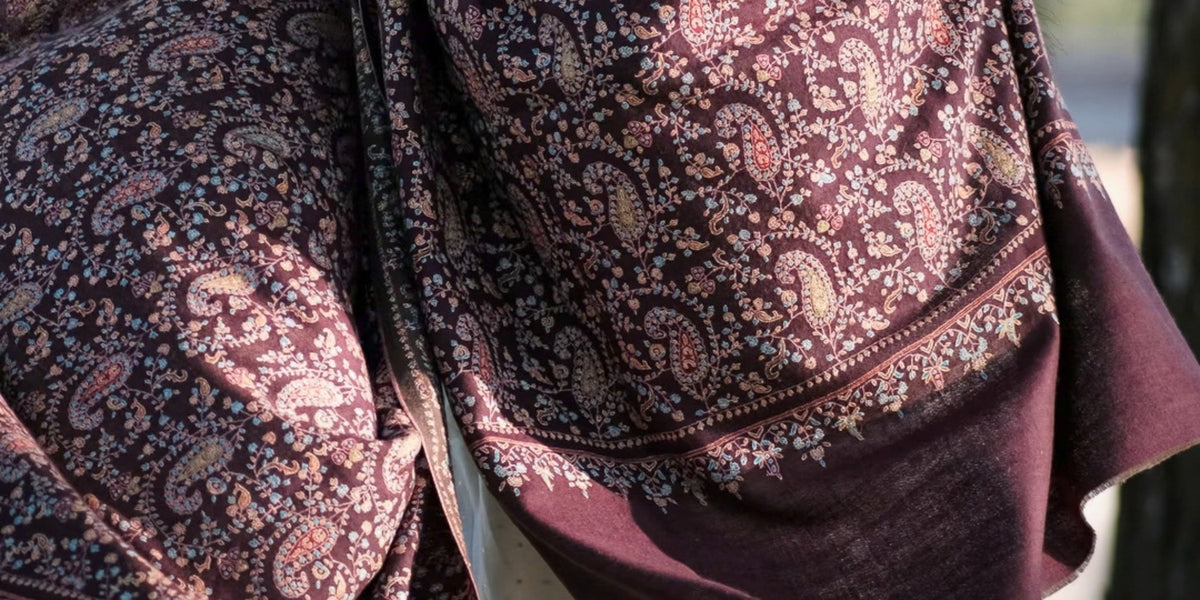
As our journal on the buta explains in full, the motif's evolution is documented step by step on surviving shawls: from the Mughal flowering plant of the seventeenth century, through cypress and bouquet forms, to the outlined bent tip cone of around 1820. Later cultures assigned their own meanings to the final form and named it after a Scottish mill town, but the design originated in Kashmir, was created by Kashmiri hands, and its true name is the buta.
Myth six: the craft of the woven shawl is extinct
It very nearly was. Commercial Kani weaving came to an end in the late nineteenth century and remained dormant for a hundred years. However, the technique survived, passed on privately from father to son within Srinagar weaving families and kept alive at Kanihama, and since the late 1990s the Kani shawl has once again been woven in the valley, using the same talim script and the same simple looms. The piece you purchase today is a continuation, not a reproduction.
Myth seven: machine made can equal handmade
For most textiles, honestly, machines have won. Pashmina is the exception, for a physical reason: genuinely hand spun Pashmina yarn is too fine and too delicate for power looms. Industrial workarounds exist, reinforcing the yarn with synthetic thread and dissolving it out with acid after weaving, but the acid weakens the very fibres the buyer is paying for. The hand processes survive in Kashmir not as nostalgia but because they remain the only methods the material itself will accept.
Truth is a competitive advantage in a market of legends. Ask your questions, turn the shawl over, and buy from hands you can trace.
Buy authentic shawls from Veave Lore
FAQs
Does the goat suffer when the Pashmina is obtained?
No. The spring down is combed out after it has loosened naturally, in stages timed to the comfort of the animal, by herders whose livelihood and religious culture both depend on the wellbeing of their flocks.
Is shahtoosh the same as Pashmina?
No. Shahtoosh came from the wild Tibetan antelope, killed for its down; the trade is banned worldwide. Pashmina is collected harmlessly from the domesticated Changthangi goat.
Is the ring test reliable when buying?
Use it as a curiosity, never as proof. It demonstrates lightness, which many fabrics can fake, and fails dense, genuine pieces. Provenance, hand spun yarn character, and the reverse of the work are far better evidence.
Is everything sold as pashmina actually Pashmina?
No. The word is widely applied to blends and machine woven wraps of unrelated origin. Genuine Kashmiri Pashmina means Ladakhi fibre, hand spinning, and hand weaving in Kashmir; ask for all three.
Was the woven Kani shawl ever truly lost?
Commercially, it disappeared for about a century, but the knowledge survived in Srinagar weaving families and at Kanihama, and today's revival descends from those unbroken lines.

Written by Veave Lore


Leave a comment
This site is protected by hCaptcha and the hCaptcha Privacy Policy and Terms of Service apply.