







Kani Weaving and the Talim: The Coded Language of the Kashmir Shawl
Look closely at the back of a true Kani shawl and you will see something no printed or machine made imitation can fake: at every change of colour, a minute ridge where two threads of different shades loop around each other, row after row, across the entire cloth. Each of those loops was placed by hand. A single line of weft in a dense design can require hundreds of separate insertions, each made with a small eyeless wooden bobbin called a kani. This is the technique textile scholars call twill tapestry, and in its Kashmiri form it stands among the finest weaving traditions the world has produced.
What makes Kani different
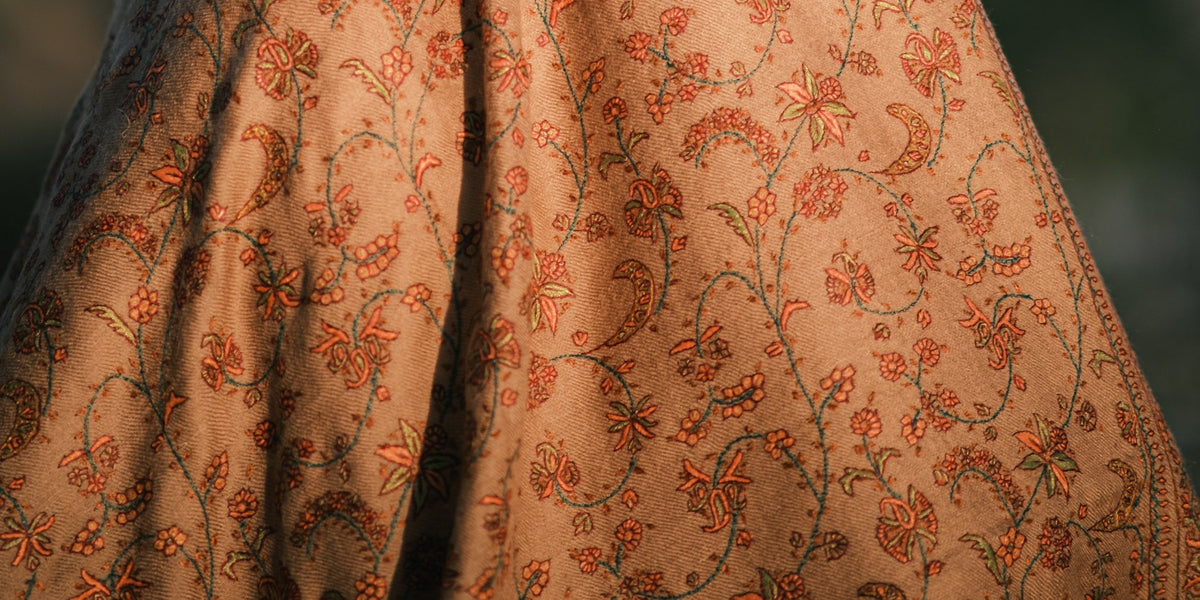
Most patterned cloth in the world is brocade: extra decorative threads floated over a plain structural weave. Tapestry is something rarer. In tapestry, the coloured threads that form the picture are the structure of the cloth itself. And Kashmir's version is rarer still, because it is woven not in a plain weave, as almost every other tapestry tradition on earth is, from ancient Egypt to the Andes, but in a fine 2x2 twill, the diagonal ribbed weave that gives Pashmina its drape. Where two colours meet, the wefts interlock in a double loop, creating a join so firm and clean that the pattern reads with perfect sharpness on the face of the cloth.
The numbers involved are difficult to believe for a woollen textile. Classic Kani cloth commonly carries thirty to thirty six warp threads and up to forty eight weft threads in every centimetre, counts comparable to fine silk. On such a microscopic grid, the weaver builds flowers.
The talim: a design written in code
Here is the feature that exists nowhere else in the world of textiles. A Kani design does not sit under the warp as a picture for the weaver to copy. It is first drawn freehand by the designer, the Naqash, whose sureness of hand astonished every foreign observer who ever watched one work. The drawing is transferred to point paper, the weaver's graph paper, and then translated, line of weft by line of weft, into a written shorthand called the talim: a script of symbols that records, for every row, how many pairs of warp threads to lift and which colour to insert.
In the great workshops of the nineteenth century, a master would call the talim aloud, three pairs red, eight green, four blue, and the weavers' fingers followed. Today's weavers are literate in the code and read it directly from the sheet, and software now assists in converting a scanned design into talim, a bridge between the eighteenth century and the twenty first. But the essence is unchanged: the talim means an entire shawl, with all its curves and blossoms, can be stored on a few small sheets of paper and reproduced exactly, decades later, by hands that never saw the original. It is a complete pattern language, invented in Kashmir and used nowhere else on earth, save in the Kashmiri carpet workshops that later borrowed it.
The pace of the work
Kani weaving is slow in a way modern life has almost no reference for. A nineteenth century observer famously reckoned a day's progress on a densely patterned piece at less than the length of a barley grain. Today, a ladies' shawl of about two metres by one, patterned all over, occupies two weavers sitting side by side at one loom for six to nine months. In the craft's nineteenth century golden age, when European demand drove designs to their most elaborate, a single shawl might be divided among a dozen or more looms weaving matching sections simultaneously, the finished pieces joined afterwards by the rafugar with seams so fine they can only be found by searching for them.
Death and resurrection
By about 1880, changing fashion in Europe and cheap machine imitations had collapsed the market, and within a generation commercial Kani weaving was gone. For most of the twentieth century the craft was believed extinct. It was not. In a handful of Srinagar weaving families, fathers quietly taught sons the technique across the barren decades, with no market and no reward, purely so that the knowledge would not die. When Indian prosperity revived demand in the late 1990s, those families were ready, and the Kani shawl returned to the loom after a century of silence. Alongside them, the village of Kanihama, whose very name recalls the bobbins once made there, had kept training hands in the technique.
That survival, skill held in trust through generations that could not profit from it, is to our mind the single most moving fact in the entire history of this craft. Every Kani piece in the Veave Lore collection descends directly from it, woven today on the same simple looms, from the same talim script, in the same valley.
Frequently Asked Questions
What does kani mean?
Kani is the Kashmiri word for the small eyeless wooden bobbin, wound with coloured yarn, used to insert the pattern wefts. By extension it names the whole technique of twill tapestry weaving and the shawls made by it. A complex design may have hundreds of kanis in play on a single loom.
What is a talim?
The talim is Kashmir's unique weaving code: a shorthand script recording, row by row, the number of warp threads to lift and the colour to insert. It allows any design, however intricate, to be written down on paper and woven exactly by any trained weaver.
Why do Kani shawls cost so much?
Time. Two skilled weavers spend six to nine months, sometimes longer, on one all over patterned shawl, after the design, talim writing, dyeing, and warping are complete. The price largely reflects months of paid skilled labour, not a brand markup.
How can I tell a real Kani shawl from a printed imitation?
Turn it over. A genuine Kani shawl shows tiny ridges of interlocked colour at every boundary of the design on the reverse, and the pattern is part of the cloth's very structure. A print sits on the surface and fades; a jacquard imitation shows long loose floats or a fuzzy trimmed back.
Did Kani weaving really die out?
Commercially, yes, from roughly the 1880s until the late 1990s. But the technique survived unbroken inside a few Srinagar weaving families and through training at Kanihama, which is why today's revival is a true continuation and not a reconstruction.

Written by Veave Lore

Leave a comment
This site is protected by hCaptcha and the hCaptcha Privacy Policy and Terms of Service apply.