






The GI Tag and the Fight Against Fake Pashmina
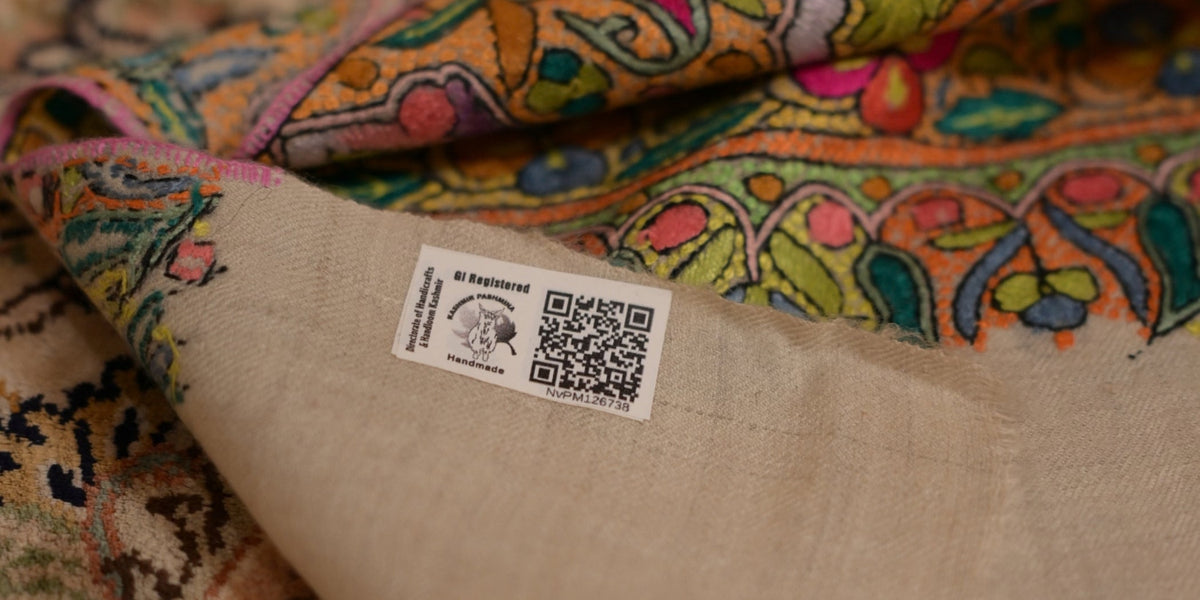
There is a small mark on a genuine Kashmir Pashmina label that most buyers pass over without noticing: a Geographical Indication tag. It looks unimpressive, a few printed words and a registration number. In reality, it is one of the very few legal protections available to guard a four-hundred-year-old craft against a global market filled with imitations that borrow its name.
What a GI Tag Actually Protects
A Geographical Indication is a form of legal recognition that links a product's name to a particular place and a specific traditional method, as with names such as Champagne or Darjeeling tea. Its purpose is to prevent a name built up over generations of regional expertise from being used by producers with no connection to that place or that method. In the case of Kashmiri Pashmina, the indication means the name is legally reserved for Pashmina obtained and processed by the officially recognised traditional method, not for any soft wool blanket that decides to adopt a respected term.
How Kashmir Pashmina Earned Its Tag
Kashmiri Pashmina was officially granted Geographical Indication status in India in 2008, as part of a broader initiative by regional craft development organisations to record and safeguard the traditional methods behind the area's textile heritage. It was not the only Kashmiri craft to achieve this recognition; separate registrations have been granted for related techniques such as Kani shawl weaving and Sozni embroidery, each resting on the same principle: a name earned through centuries of particular, documented skill deserves a legal boundary around it.
What the Tag Can and Cannot Do
In India a GI tag is a powerful instrument, since it has the force of law and can be used to challenge false labelling. It becomes a weaker tool as soon as a shawl enters a market governed by different rules, which is one of the main reasons the term pashmina is still used loosely all over the world for fabrics with no connection to Kashmir. Nor does the tag automatically qualify every shawl a seller offers; permission to use it is given only to registered producers who meet the required standards, so the tag only means something when it is genuinely linked to a specific, accountable maker rather than printed as decoration.
What Buyers Should Actually Look For
Think of the GI tag as one honest indication among many, not as a substitute for asking direct questions. A reliable seller should be able to state clearly whether the fibre comes from Ladakh, whether the weaving or embroidery was carried out in Kashmir, and whether they can produce documentation to support that claim. When a tag is accompanied by that kind of transparency, it has value. If the tag is the only information on a listing that cannot answer a single specific question about origin, it carries considerably less weight.
Frequently Asked Questions
What is the significance of a GI tag for Pashmina?
It legally links the name Kashmir Pashmina to fibre obtained and processed by the recognised traditional method in the specified area, much as the name Champagne is protected in relation to a particular place and process.
When was Kashmir Pashmina given GI status?
It was granted Geographical Indication status in India in 2008, as part of a wider initiative to formally protect a number of traditional Kashmiri crafts.
Does a GI tag guarantee that a shawl is genuine?
In India it is a strong indication but not, by itself, an absolute guarantee. The tag carries weight when it is backed by a specific, accountable producer, and much less when it is printed without a traceable source.
Are other Kashmiri crafts also protected by GI tags?
Yes. Kani shawl weaving and Sozni embroidery each hold their own Geographical Indication registration, alongside Kashmir Pashmina.
How can a buyer check that a seller's Pashmina is genuine?
Ask directly about the origin of the fibre and where the weaving or embroidery took place; a genuine seller answers specifically and confidently. The best combination to look for is a Geographical Indication reference backed by a producer who can trace their own supply chain.

Written by Veave Lore



Leave a comment
This site is protected by hCaptcha and the hCaptcha Privacy Policy and Terms of Service apply.