






A Century of Silence: The Death and Rebirth of the Kani Shawl
Crafts die quietly. There is no announcement, no last day; there is simply a year in which, for the first time in centuries, no one weaves. For the Kani shawl of Kashmir, the most elaborate weaving tradition India ever produced, that silence began in the 1880s and lasted a hundred years. This is the story of how it fell, how it secretly survived, and how it came back, and it is, we believe, the finest story in the entire history of the craft.
The Fall
The numbers of the collapse still shock. At its 1860s peak the valley's annual shawl export stood at its all-time high; within thirty years it had fallen by more than ninety five percent, and observers were describing the industry as moribund. The popular legend blames a single event, the Franco-Prussian War of 1870, for severing French demand at a stroke. The truth, as the trade figures show, is less cinematic: exports held up for a decade after that war, and what killed the woven shawl was the slower, surer combination of changing European fashion, the flood of Jacquard and printed imitations, and a workforce that generations of exploitation had left with no reason to hold on. By the 1890s the great Kani looms were still. The embroidered shawl, cheaper and quicker to make, survived on Indian demand, and the wider craft with it; but the loom-woven masterpiece, the technique that had clothed the Mughal court, was commercially extinct.
The Secret
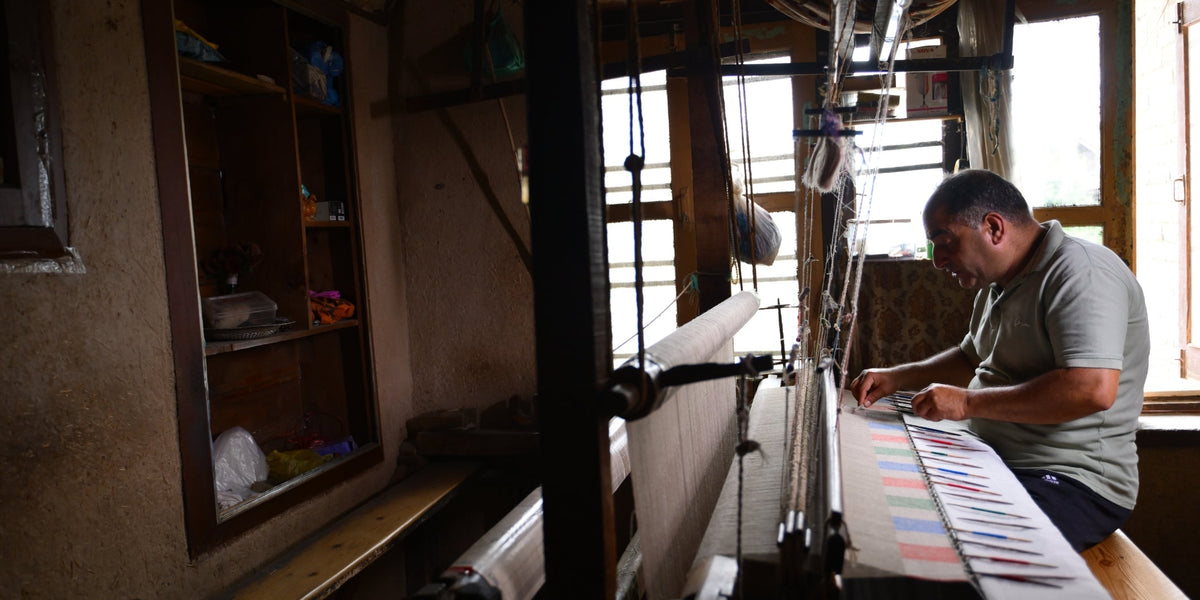
For most of the twentieth century, the world assumed the skill had died with the market. The world was wrong, in two ways. The first was Kanihama, a village whose very name recalls the kani bobbins once made there, where an enthusiast trained young men in the technique generation after generation, keeping a small pool of hands proficient even when the only available materials were humble local wools. The second, invisible even to close observers until decades later, was quieter and more moving still: inside a number of Srinagar weaving families, fathers simply kept teaching the technique to their sons. One master, born around 1880 and himself of the last commercial generation, was still training boys in his nineties; those boys learned the skill, found no market for it, wove plain cloth for a living, and taught their own sons anyway. In some families the chain was never broken at all. There was no subsidy for this, no buyer, no rational prospect of one. There was only the conviction that what their ancestors had known was too valuable to be allowed to vanish, held by the very class of artisans the nineteenth century had treated worst.
The Return
Demand came back the way it left: through fashion and prosperity, this time India's own. From the late 1990s, as Indian buyers rediscovered the classic shawl, the hidden skill stepped back into the light. The trained hands of Kanihama and the weaving families of Srinagar returned to patterned work, the talim script, which had waited patiently on paper and in the carpet workshops that had borrowed it, resumed its original purpose, and for the first time in a century, Kani shawls were woven in the valley as living commerce rather than museum memory. Today two weavers at a loom will spend the better part of a year on a fine piece, exactly as their great-great-grandfathers did, and the first decade of this century saw the craft not merely surviving but reinventing itself, with the revival still gathering strength.
Every Kani piece at Veave Lore descends from that unbroken, hidden lineage. When you buy one, you are not buying a revival product. You are buying the vindication of the families who refused, through a hundred profitless years, to let the knowledge die. We can think of no deeper meaning the word heirloom could carry.
Frequently Asked Questions
Did the Franco-Prussian War really kill the Kashmir shawl industry?
That is the legend, but export records show the trade held for a decade after 1870. The true causes were changing European fashion, mass produced imitations, and the accumulated weaknesses of an exploited industry; the collapse came through the 1880s.
Was Kani weaving completely lost?
Commercially, yes, for about a century. But the technique survived through training at Kanihama village and, unseen by outsiders, through Srinagar weaving families who passed it from father to son with no market to reward them.
When did Kani weaving revive?
From the late 1990s, driven by renewed Indian demand for the classic shawl. The preserved skills, together with the surviving talim system, allowed a true continuation rather than a reconstruction.
How long does a Kani shawl take to weave today?
A fully patterned piece typically occupies two weavers at one loom for six to nine months, after design, talim writing, dyeing, and warping, essentially the rhythm of the craft's golden age.
How do I know a modern Kani shawl is genuine?
By its construction: the pattern is the structure of the cloth, showing interlocked colour joins on the reverse, and by the maker's provenance. Ask which hands wove it; a true house can answer.

Written by Veave Lore

Leave a comment
This site is protected by hCaptcha and the hCaptcha Privacy Policy and Terms of Service apply.