






Tilla Embroidery: Kashmir's Gold Thread Craft
If you walk around the old part of Srinagar in the weeks leading up to the wedding season, you will hear two different types of embroidery before you see them. Sozni work is almost silent, consisting of a fine needle going repeatedly through the wool. Tilla work makes a slight metallic noise, the thread, unlike silk, being pulled into patterns one stitch at a time. This is Kashmir's other form of embroidery, in spirit older than its appearance suggests, and much less discussed than its softer and more well-known sibling.
What Tilla Actually Is
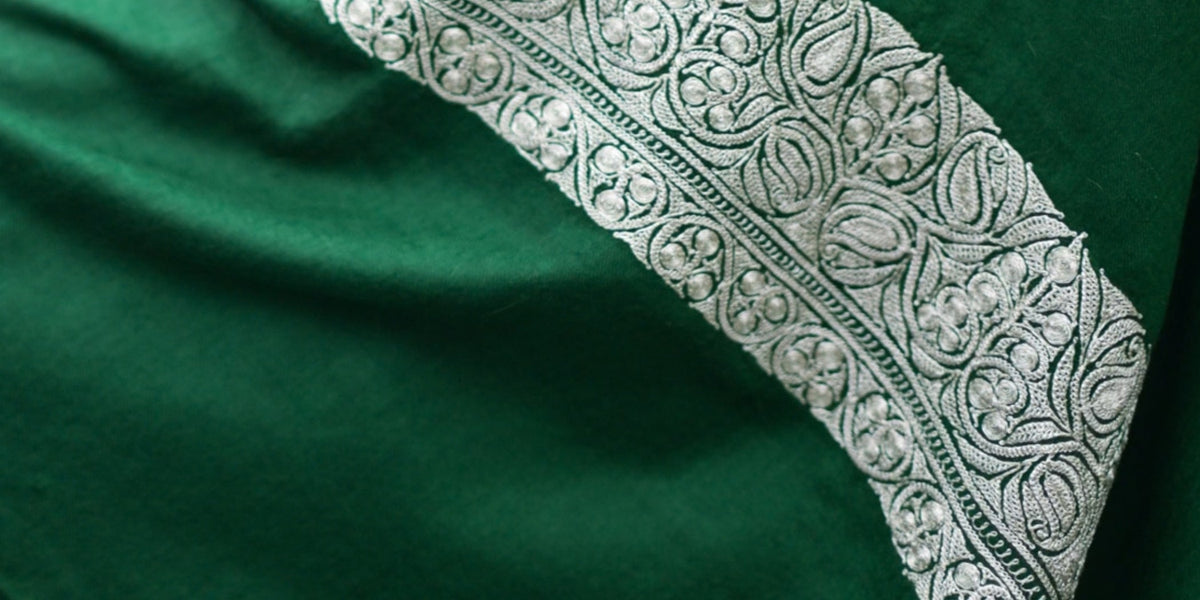
The term Tilla refers to metal thread, which in historical times was a thin strip of actual gold or silver that had been flattened and wound around a silk core, and even nowadays it is made from a thread coated with metal while retaining the same stiffness. This stiffness is indeed the essential feature and also the main challenge. Since metal thread cannot be drawn through the fabric like silk or wool without breaking or fraying, the artisan lays it flat on the surface of the fabric and holds it in position with small, almost invisible stitches made with regular thread. This technique is known as couching and is slower and less forgiving than embroidery that goes directly through the cloth, since any error cannot simply be pulled out without damaging both the metal thread and the fabric underneath.
Where Tilla Appears
Tilla is part of Kashmir's most formal clothing. It is featured on the phiran, the traditional winter coat, in the form of bands round the collar and at the cuffs. It also covers the top part of the small Kashmiri cap. When used on a Pashmina, it most commonly appears as a thick border rather than as a design covering the entire surface, acting in the way that a gold frame enhances a painting rather than covering the painting itself. Heavier fabrics, such as wool and particularly Jamawar-weight Pashmina, better support the weight of metal thread, which is why Tilla and the finest, most delicate weaves are rarely found on the same piece.
Tilla Beside Sozni and Kani
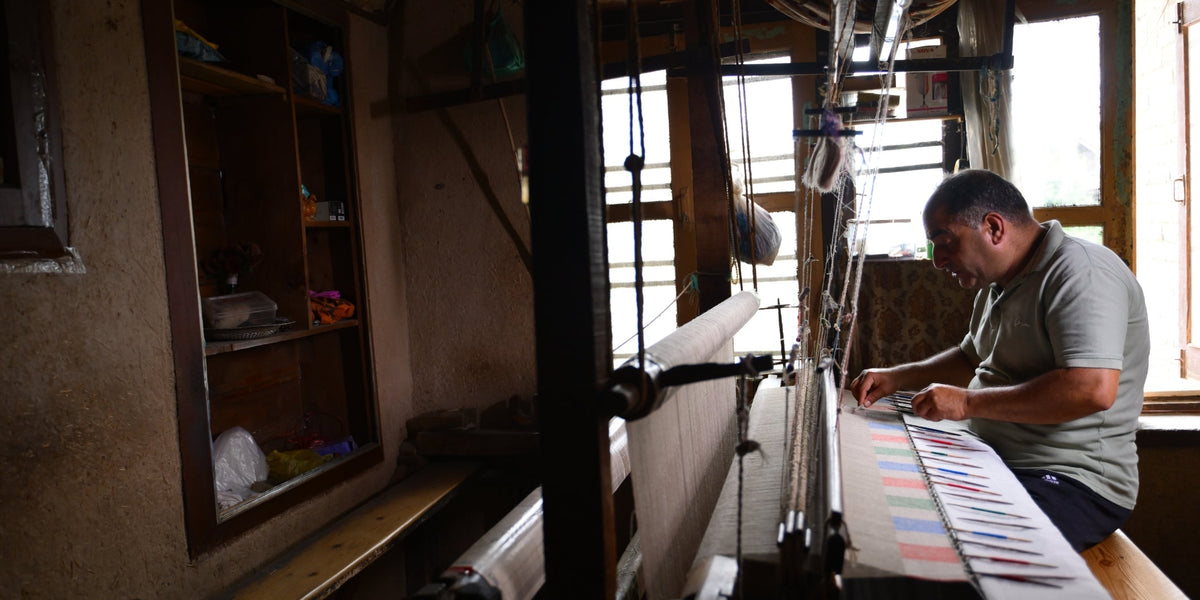
The three embroidery and weaving techniques of Kashmir deal with the same issue, that of decoration, in three different manners, and each one requires its own specialist. In Kani, the pattern is incorporated into the fabric as it is being woven, bobbin by bobbin. With Sozni, the pattern is worked onto the completed cloth using a needle and a silk thread, in such a way that the back of the design looks almost as neat as the front. Tilla does neither; it adds the pattern in a material which the loom and the needle cannot otherwise employ, and it appears as if metalwork has been placed onto the cloth rather than thread woven into it. A weaver, a Sozni artisan and a Tilla artisan are rarely the same person, and a single ceremonial shawl may go through all three hands before it is finished.
The Hands Behind the Gold
Traditionally, people have learned Tilla work within their families and in small workshops, taking many years rather than just a few months, since the material rewards patience in a manner that silk thread does not. An apprentice has to go through a long period of training just to learn how to maintain even tension in a thread which has no natural elasticity, placing each piece so that it catches the light without bending or rising. The craft has always been carried forward by a smaller group of artisans than Sozni, both because the training takes so long and because the market for complete Tilla work, heavy, formal and expensive, has always been narrower than that for lighter embroidery.
A well-made Tilla border achieves something that neither printed nor machine-made trim can reproduce: it catches the light unevenly, just as hand-laid metal always does, which is why the pattern appears to move as the shawl moves. This slight, natural irregularity is the same characteristic that identifies all genuine Kashmiri crafts, whether the hand is holding a needle threaded with silk or one that is working with gold.
Frequently Asked Questions
What material is used in Tilla embroidery?
Traditionally, the thread consisted of a thin strip of actual gold or silver wound around a silk core. Nowadays, most Tilla work uses a metal-coated thread with the same stiffness and shine, since pure gold and silver wire are now rare and expensive.
Is Tilla work the same as Sozni embroidery?
No. Sozni involves drawing silk thread through the fabric with a needle to create a floral pattern, the design often being almost as neat on the back as on the front. Tilla consists of laying metal thread on the surface and holding it in place with couching stitches, since the metal cannot go through the fabric without breaking.
Can Tilla work be carried out on a Pashmina shawl?
Yes, most commonly as a border rather than covering the entire surface. It suits heavier weaves and formal garments intended for weddings and festive occasions, since the weight of the metal thread requires a more substantial base than the lightest shawls can offer.
Why does real Tilla work cost more than printed metallic trim?
Each length of thread is laid and stitched down by hand, one small section at a time, by an artisan trained over years to maintain even tension. No machine can produce the same texture or durability.
How should a piece with Tilla embroidery be cared for?
Do not fold it directly across the embroidered area; store it flat or loosely rolled, keep it from rubbing against rough surfaces, and have it professionally cleaned by someone experienced with metal thread rather than cleaning it at home.

Written by Veave Lore


Leave a comment
This site is protected by hCaptcha and the hCaptcha Privacy Policy and Terms of Service apply.