






The Buta: How a Kashmiri Flower Became the World's Paisley
Ask the world what a paisley is and you get a teardrop, a mango, a Persian pickle, a swirl on a necktie. The true answer is that the paisley is Kashmiri, and its story is one of the most remarkable design journeys ever traced: two centuries of patient evolution in the sketchbooks of Kashmir's shawl designers, followed by wholesale appropriation by the industrial West.
It begins with a spring garden
In 1620 the Mughal emperor Jahangir saw the spring flowers of Kashmir for the first time and was so moved that he commissioned his court painter Mansur to make studies of them. Out of that moment, fed also by European botanical books circulating at court and by the floral silks of Iran, grew the defining motif of Mughal decorative art: a single graceful flowering plant, a bloom or two, a bud, a few leaves, rising from a small root, with a gentle sway in its stem. On the earliest surviving patterned shawls, from the later 1600s, this flower stands in a widely spaced row across each end panel of the cloth, elegant and alone against a plain field.
From flower to cypress to bouquet
Across the eighteenth century, the Kashmiri designers did something the textile artists of no other region did. Step by step, generation by generation, they transformed that single flower. First the blooms multiplied on the stem and the whole motif compressed into the tapering silhouette of a cypress tree, its topmost flower keeping the old graceful tilt. Then the single species gave way to a bouquet of many different flowers gathered into that same swaying outline. Small sprays and leaves crept into the spaces between the motifs. By the end of the century the bouquet had become a dense mosaic of tiny blossoms and the tilt of its crown had sharpened into a distinct point of bentness.
The last step occurred around 1815 to 1820. The background is totally filled with pattern and to keep the motif readable the designers drew a narrow outline of plain ground colour around its edge. At that moment the classic buta was born: the bent tipped cone, defined by its own silhouette, endlessly variable within it. What followed was an explosion of invention. Butas of big blooms and butas of flowers almost too small to see, butas nested inside butas, butas with multiple tips, butas elongated into swan necked arcs under the exuberant taste of the Sikh court. On the evidence of the surviving shawls, the variety is effectively infinite.
The theft of a name
Theft of a name At the turn of the nineteenth century, the Kashmir shawl was the rage in Europe, and European mills in France, Norwich, Vienna and Scotland were competing to produce the same designs they were unable to match. It was a jacquard loom that allowed the buta patterned shawls to be mass-produced at a tiny fraction of the cost, and one weaving town in the west of Scotland became so dominant in that trade that its name attached itself to the motif. The town was Paisley. By the century's end the word paisley meant the design itself, everywhere on earth, and its Kashmiri origin had been erased from the label.
Consider the injustice of it. The Greek key is named for Greece. The Celtic knot for the Celts. The Chinese cloud for China. Only this motif, among the great travelling designs of the world, is named for the town that copied it rather than the culture that created it. In Kashmir it was, and is, the buta. Elsewhere in India it is the badam, the almond, or the ambi and kairi, the mango. Whatever the name, its birthplace is a valley in the Himalaya, and its parents were the anonymous Naqash designers whose freehand drawing a famous nineteenth century observer judged the equal of any artist in Europe.
The buta today
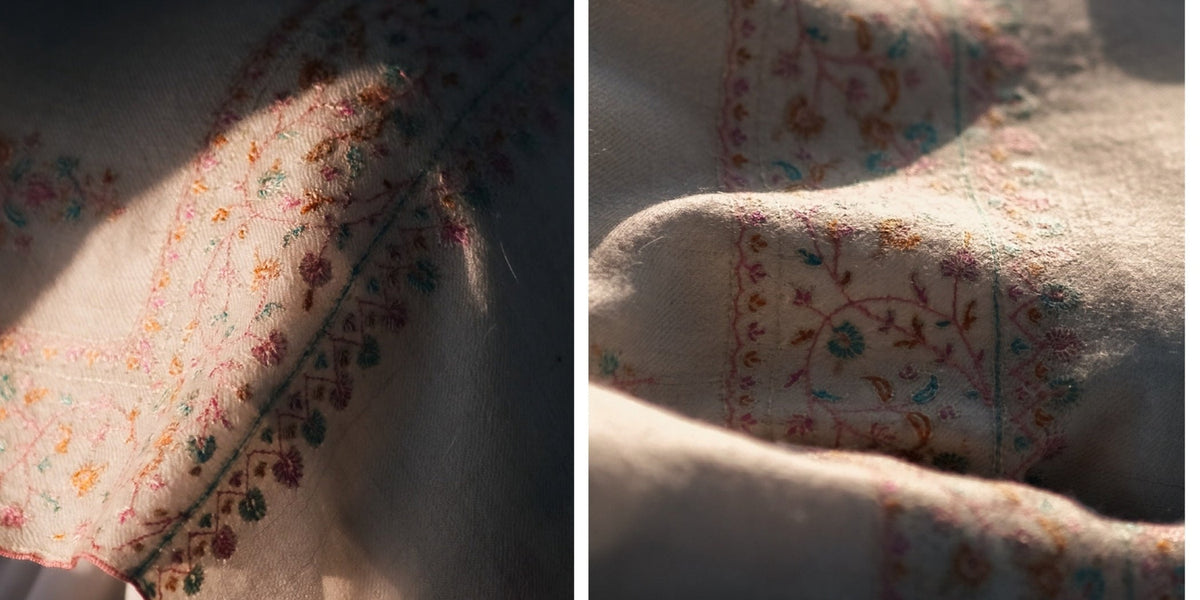
The motif never stopped travelling. It appears on carpets of the Caucasus, on metalwork of Azerbaijan, on printed cottons of Rajasthan, on silk ties in Milan. And it never stopped living at home. In the Veave Lore workshops the buta remains a working motif, woven in kani and worked in Sozni embroidery, still drawn freehand, still evolving, exactly as it has for three hundred years. When you wear it from its birthplace, you are not wearing a paisley. You are wearing a buta, and you are wearing the original.
FAQs
Where does the paisley pattern really come from?
From Kashmir. The motif evolved in Kashmiri shawl design over roughly two centuries, from the Mughal style single flowering plant of the 1600s to the bent tipped composite buta of about 1815 to 1820. European mills copied it, and the Scottish weaving town of Paisley eventually gave the copy its Western name.
What does buta mean?
Buta is the Kashmiri and Urdu term for the motif, essentially a flowering plant or bouquet. Its small cousin, a single flower repeated across a field, is called a buti. In wider India the shape is also called badam, almond, or ambi and kairi, mango.
Is the buta a mango, a teardrop, or a flame?
None of these, in origin. The surviving shawls show clearly that it began as a flowering plant and grew through cypress and bouquet stages into the outlined cone. The mango, teardrop, flame, and tree of life stories are later readings projected onto a finished form.
Why does the buta lean to one side?
The tilt descends directly from the swaying stem of the original Mughal flower. Kashmiri designers preserved that asymmetry through every stage of the motif's evolution; even near symmetrical butas almost always carry a bend at the tip. It is the motif's signature and its pulse.
Do modern Kashmiri shawls still use the buta?
Yes. The buta remains central to kani weaving and Sozni embroidery today, drawn freehand by working designers and reinterpreted in every generation, including across the Veave Lore collections.

Written by Veave Lore

Leave a comment
This site is protected by hCaptcha and the hCaptcha Privacy Policy and Terms of Service apply.