






Article: From Goat to Loom: How a Kashmiri Pashmina Shawl Is Made
From Goat to Loom: How a Kashmiri Pashmina Shawl Is Made
Raw pashm, arriving in Srinagar from the high pastures of Ladakh, does not look like luxury. It arrives as a dusty, rough clump of fine down mingled with the coarse guard hairs of the goat’s outer coat. There is nothing about it at the moment to suggest the luxurious shawl it will one day be. Between this raw fibre and the finished Pashmina is a chain of almost a dozen specialised crafts, all traditionally carried out by skilled artisans, many of whose techniques are passed down through generations. This is that journey!
Cleaning and dehairing: the invisible labour
The first task is to remove every coarse hair from the down, and for most of the craft’s four hundred year recorded history this was done entirely by hand, hair by individual hair. Hand dehairing fifty grams of fibre can take a full working day. The fibre is then cleaned by working slightly damp rice flour through small pads of down, which lifts out the natural grease and dust, and finally straightened by drawing it gently through an upright comb. From every six units of raw fibre, roughly two units of first quality down emerge, fit for the finest yarn. This stage has always belonged to the women of Kashmir, and it remains the least seen and least celebrated labour in the entire chain.
Spinning: the skill in the fingers
Pashm is spun on the same simple wheel used across northern India for cotton, and that is precisely what makes the achievement remarkable. The fibre is short, delicate, and inelastic, prone to snap under any careless tension, yet Kashmiri spinners draw from it a thread finer than any other hand spun woollen yarn in the world. Observers in the nineteenth century compared it to the legendary hand spun cotton of the Dhaka muslins. The skill lives in an almost imperceptible play of the fingers of the left hand, coordinated exactly with the wheel, and it has passed from mother to daughter for as long as anyone can trace. A hollow length of paddy straw slipped over the spindle serves as the bobbin. The finished yarn is doubled, twisted, and wound into standard hanks, counted off in bundles of twenty threads.
Dyeing sixty colours from a handful of plants
In Kashmir, dyeing is a family craft and many families guard their methods closely. The old master dyers kept their formulas secret. Historical records describe how they created more than sixty rich, long-lasting colours using just a handful of natural ingredients in different combinations and strengths. Indigo gave deep blues, lac and kermes produced reds and pinks, safflower brought warm yellows, while iron liquor was used for black. What’s remarkable is that modern studies of seventeenth and eighteenth century Kashmiri shawls have confirmed these accounts. With only five or six natural dye sources and an extraordinary understanding of layering and proportion, artisans created a vibrant palette whose colours have remained remarkably vivid even after three centuries.
Today most dye work uses reliable modern colours, but standardized natural dyes remain available, and a client who asks for them will be obliged.
Warping: a walk of many kilometres
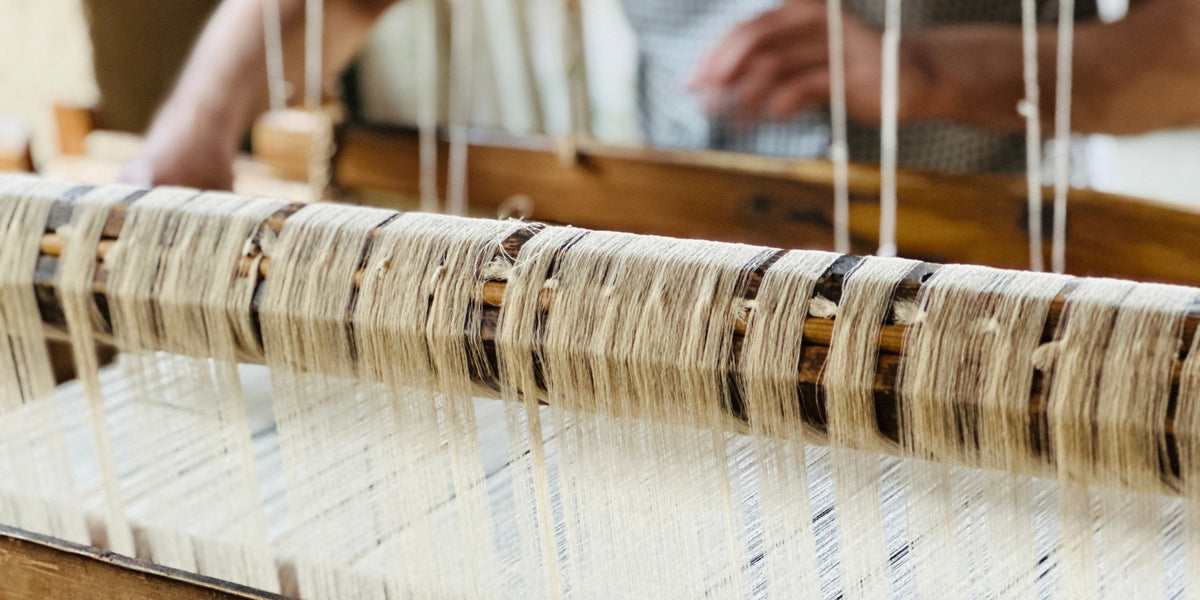
Before weaving, the warp, the two to three thousand fine threads that run the length of the fabric, must be laid. Two warpers walk up and down a long line of pegs set in the ground, guiding continuous yarn around them with a hooked cane. To lay the warp for a run of plain fabric, the pair together may walk more than twenty five kilometres. Each thread is then passed by hand, one by one and in exact order, through the eyes of the heddles by a specialist called the barrenguru, work of intense concentration where a single misplaced thread throws off the entire cloth. Today this exacting job is mostly done by women.
Weaving the loom and the throw of the shuttle
The Pashmina loom is almost startlingly simple: a wooden frame with four heddles, worked by treadles, everything else done by hand. Four heddles, rather than two, produce the twill weave, the fine diagonal rib that gives Pashmina cloth its soft drape and its subtle surface light. The mechanised flying shuttle is far too violent for yarn this fine, so plain Pashmina is woven on the age old throw and catch principle with a slim boat shaped shuttle passed from hand to hand. Plain cloth, called alwan, is the base for embroidered shawls, and is often woven in twill variants of its own, most famously the small lozenge weave called chashm e bulbul, the eye of the bulbul.
A skilled weaver takes roughly a week to a fortnight to weave a single plain shawl length. Patterned kani weaving, the subject of the next journal entry, is measured not in weeks but in months and years.
Finishing and the river
Off the loom, the cloth passes to the purusgar, the finisher who trims and evens the surface, and to the rafugar, the darner whose needle repairs any flaw invisibly; the fineness of Kashmiri rafu is famous across India in its own right. Last comes the wash. The shawls are taken to the river, rubbed, trampled, and beaten on stone with a vigour that alarms every first time observer, then rinsed in the soft Himalayan water to which Kashmiris have always credited part of the shawl’s inimitable handle. The cloth comes out softer, fuller and ready to be embroidered or worn.
By the time a hand woven Kashmiri Pashmina reaches your hands, it has already passed through many hands. And behind the softness are herding families in Ladakh, women spinning fine yarns patiently, artisans mastering natural dyes, warpers preparing thousands of threads and weavers spending weeks bringing the fabric to life.
Each shawl is a shared skill, patience and traditions passed down through the generations. At Veave Lore, heritage has always been about this a craft made by people, not machines, a legacy we have carried on proudly since 1881.
FAQs
How long does it take to make one Pashmina shawl?
For a plain handwoven shawl, the weaving alone takes one to two weeks, after weeks of cleaning, spinning, and preparation.
Why is real Pashmina always handwoven?
Pure hand spun Pashmina yarn is too delicate for power looms and even for the flying shuttle. Fabric sold as machine woven pure Pashmina is usually made by reinforcing the yarn with synthetic thread that is dissolved out with acid afterwards, a process that damages the fibre. Hand weaving is not nostalgia; it is the only method the fibre itself permits.
What is alwan?
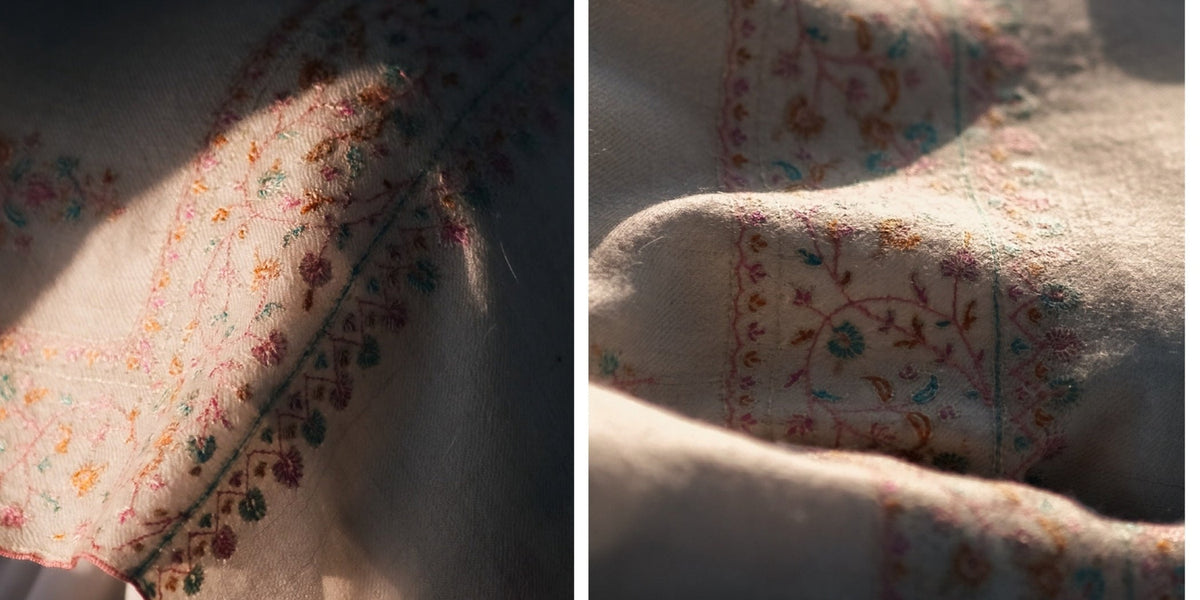
Alwan is the Kashmiri term for plain, undecorated Pashmina cloth woven in twill. It is the base fabric on which Sozni hand embroidery is worked, and a fine plain shawl is a classic in its own right.
Are natural dyes still used?
Yes, on request. Most contemporary dyeing uses dependable modern colours, but standardized natural dyes are available, and the historic palette of indigo, lac, and safflower is part of the craft’s living memory.
What does washing in the river do?
The final wash removes the last traces of dressing and relaxes the weave, giving the cloth its full softness and drape. Kashmiri tradition holds that the valley’s soft water itself contributes to the shawl’s celebrated handle.

Written by Veave Lore

Leave a comment
This site is protected by hCaptcha and the hCaptcha Privacy Policy and Terms of Service apply.