






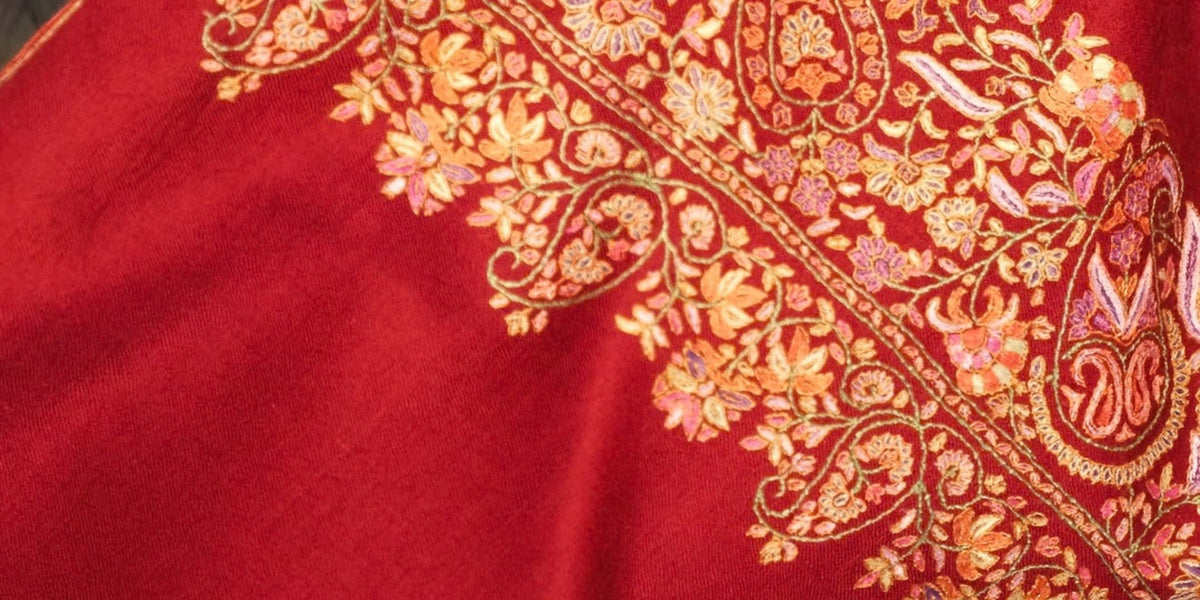
Draped in Portraits: The Kashmir Shawl in European Art and Fashion
For about seventy years, roughly from 1800 to 1870, the single most desired accessory of a fashionable European woman was a length of handwoven cloth from a Himalayan valley she would never see. The European age of the Kashmir shawl is one of fashion history's great episodes, and it left behind a gallery of masterpieces, a mountain of imitations, and a lesson about what machines can and cannot copy.
An empress sets the fashion
Shawls had trickled into Europe through the eighteenth century in the baggage of East India Company men, but the mania proper ignited when officers of Napoleon's Egyptian campaign of 1798 brought them home for their wives. Napoleon presented shawls to Josephine, and the future empress embraced them on a legendary scale: contemporaries credited her with owning anywhere from sixty to four hundred. Her patronage fixed the long Kashmiri shawl at the summit of European fashion. Its appeal was practical as well as exotic: in the era of thin neoclassical muslin dresses, a fabric that was featherlight yet genuinely warm answered a real need, and the infinite ways it could be draped meant a lady might be praised less for being well dressed than for being well draped.
The painters' favourite prop
Portrait painters adored the shawl, none more than Ingres, whose sitters wear identifiable Kashmiri pieces rendered stroke by stroke, down to recognisable khat-rast stripes and butas. Across England, France, and Russia, the shawl became visual shorthand for wealth, taste, and a hint of the East. Those canvases now serve historians as a dated record of design evolution, and they serve us as proof of how completely one valley's craft had captured the world's imagination.
Everyone wants one: the imitation industry
Where demand runs ahead of supply, imitation follows. Norwich embroidered designs on fine twill; Edinburgh adapted its damask looms; France developed handwoven twill tapestry of its own, and by 1816 could spin pure fibre yarn for complete French Kashmirs. But the decisive weapon was the Jacquard loom, whose punched cards could reproduce a buta design mechanically, and which the Scottish town of Paisley adopted so successfully from the 1820s that its name swallowed the motif itself. Below the woven imitations came the printed ones, produced by the hundred thousand, so that by mid century a factory girl could wear a cotton print echoing, at great distance, the shawl of an empress. In Scotland the shawl even entered folk ritual: a bride of any standing received a kirking shawl, white field and deep patterned end panels in the Kashmiri manner, to wear on her first appearance at church.
Yet the makers themselves admitted the ceiling they could not break. Jacquard cloth carried its floating threads and its trimmed back; printed cloth carried only a picture. Contemporary observers conceded that nothing produced in Europe approached the softness and delicacy of the genuine article. The hand spun fibre and the interlocked weave of Kashmir remained, in the exact sense, inimitable.
The end of the affair
Fashions die, and this one died quickly. In the 1870s the silhouette changed: the crinoline over which a shawl draped so gracefully gave way to the bustle and the fitted coat, which a shawl merely hid. Cheap imitations had meanwhile drained the design of its exclusivity. Export figures from the valley tell the story with brutal clarity, collapsing within two decades from their all-time peak to almost nothing. Europe moved on, and the great Kani looms of Srinagar fell silent for a century.
But here is the part of the story Europe rarely tells: in India, the shawl never fell, because in India it was never a trend. And when the craft revived in our own time, it revived at home, in the valley, in the same families. The portraits hang in the museums of Paris and London. The living craft is here.
Frequently Asked Questions
Why were Kashmir shawls so popular in nineteenth century Europe?
They combined rarity, expense, exotic design, and real practicality: exceptional warmth at almost no weight, at a time when fashionable dresses were thin. Empress Josephine's patronage made them the defining status accessory of the age.
Did European mills ever equal the Kashmiri original?
No. Jacquard and printed imitations captured the look at a distance, but observers of the time acknowledged that European products never approached the softness and fineness of true handwoven Pashmina.
What is a kirking shawl?
A Scottish wedding tradition of the mid nineteenth century: a shawl in the Kashmiri style, plain white field with deep patterned end panels, given to a bride and worn to church after her marriage.
Why did the European shawl fashion end?
A change of dress silhouette in the 1870s, the flood of cheap imitations, and shifting taste ended the mode within about two decades, collapsing the export market on which the woven shawl industry then depended.
Where can original nineteenth century Kashmir shawls be seen?
Major textile collections in Europe, North America, and India hold classic pieces, and they appear constantly in nineteenth century portraiture, most famously in the works of Ingres.

Written by Veave Lore

Leave a comment
This site is protected by hCaptcha and the hCaptcha Privacy Policy and Terms of Service apply.