






Difference Between Pashmina and Cashmere
Here is a piece of history that explains a century and a half of confusion. In the nineteenth century, Western buyers knew the fine goat fibre of high Asia only through one object: the shawl of Kashmir. So they named the fibre after the place, and cashmere entered the world's languages as the name for the down of every fleece bearing goat from Mongolia to Iran. The word is, literally, the name of our homeland spelled in a colonial accent. The more exact and older term is Pashmina, where pashm is the raw down, and the yarn and cloth made from it in Kashmir is Pashmina.
So the actual thing is that Pashmina and cashmere belong to the same family of fibre. The real differences, and they are large, lie in where the fibre comes from, how fine it is, and above all what hands do with it.
Difference One: The Fibre
Today, most of the world's cashmere is produced in Mongolia and in Inner Mongolia and other regions of China, from breeds of goat different from our own, and it is graded across a spectrum from exceptional to ordinary. Two sweaters, both labeled one hundred per cent cashmere, can be worlds apart in fineness and durability. By contrast, Kashmiri Pashmina is sourced from one animal, the Changthangi goat of the Ladakh region, whose high altitude down is at the very fine end of the international scale, normally twelve to sixteen microns, with the long staple required for hand spinning.
Difference Two: The Hands
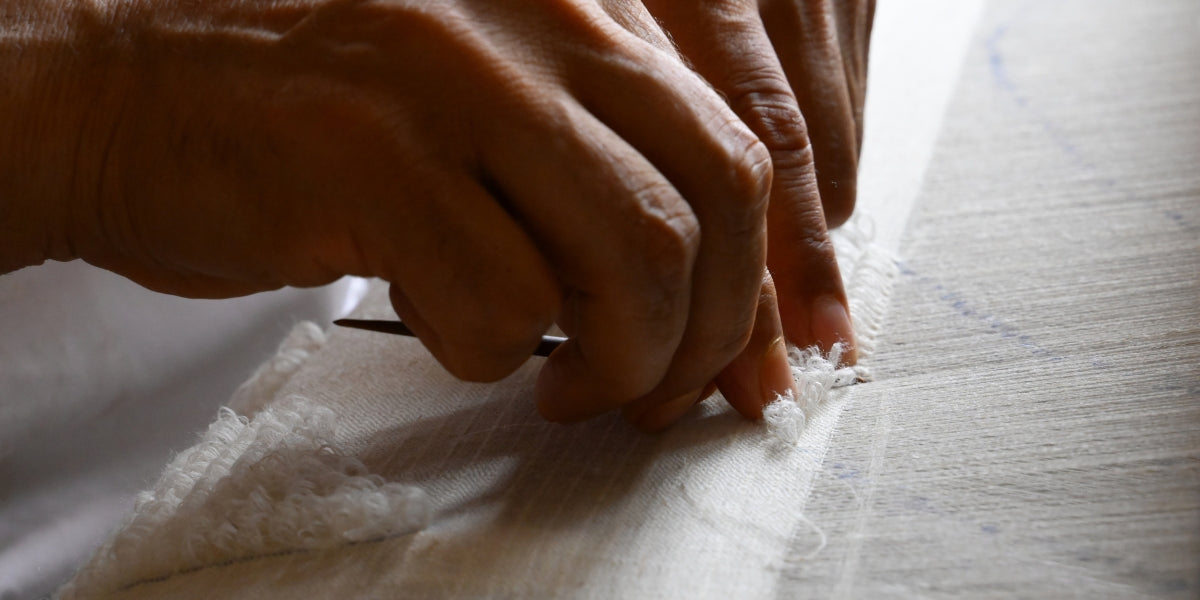
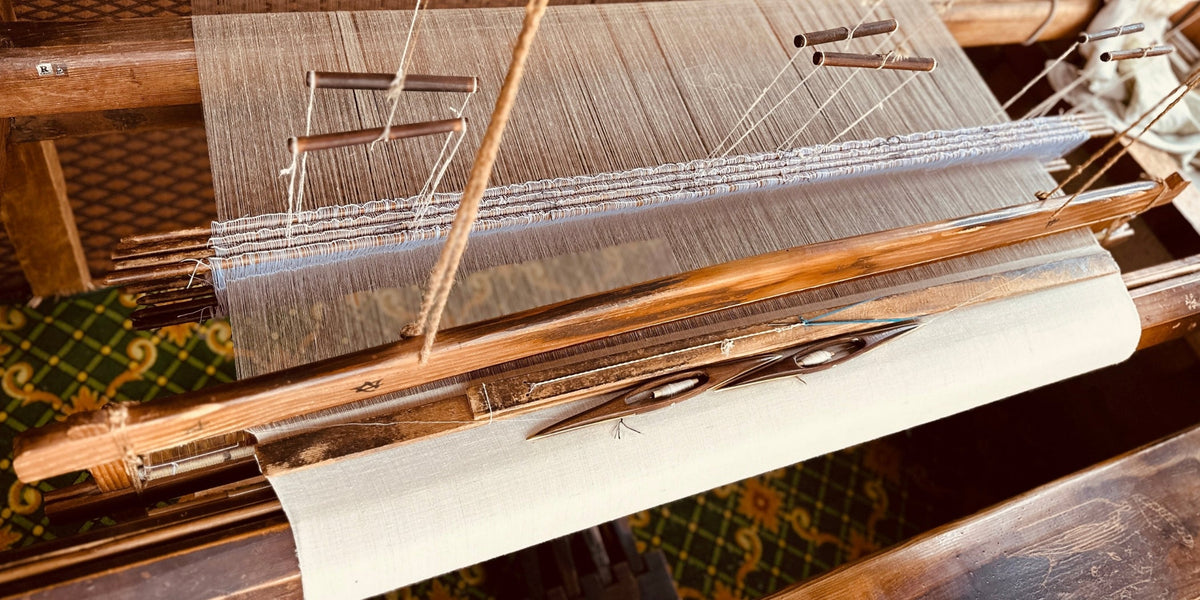
This is the divide that matters most. The global cashmere industry is a triumph of machinery: mechanical dehairing, mill spinning, power loom weaving and machine knitting, producing excellent garments at every price. Kashmiri Pashmina is the opposite proposition. The traditional fibre is dehaired with human patience, spun on a wheel by hand into a yarn finer than any machine equivalent in wool, woven thread by thread on a handloom, and finished by specialists whose trades are older than most nations. Machinery is not avoided out of sentiment; genuinely hand spun Pashmina yarn is too delicate for industrial looms, which is why true handwoven Pashmina cannot be mass produced, and why it costs what it costs.
A caution follows from this: Fabric is sometimes sold as pure Pashmina that was woven on power looms from yarn reinforced with synthetic thread, the synthetic later dissolved out with acid. The label may be technically defensible; the cloth, its fibres weakened, is not the real thing in any sense that matters.
Difference Three: The Tradition on the Cloth
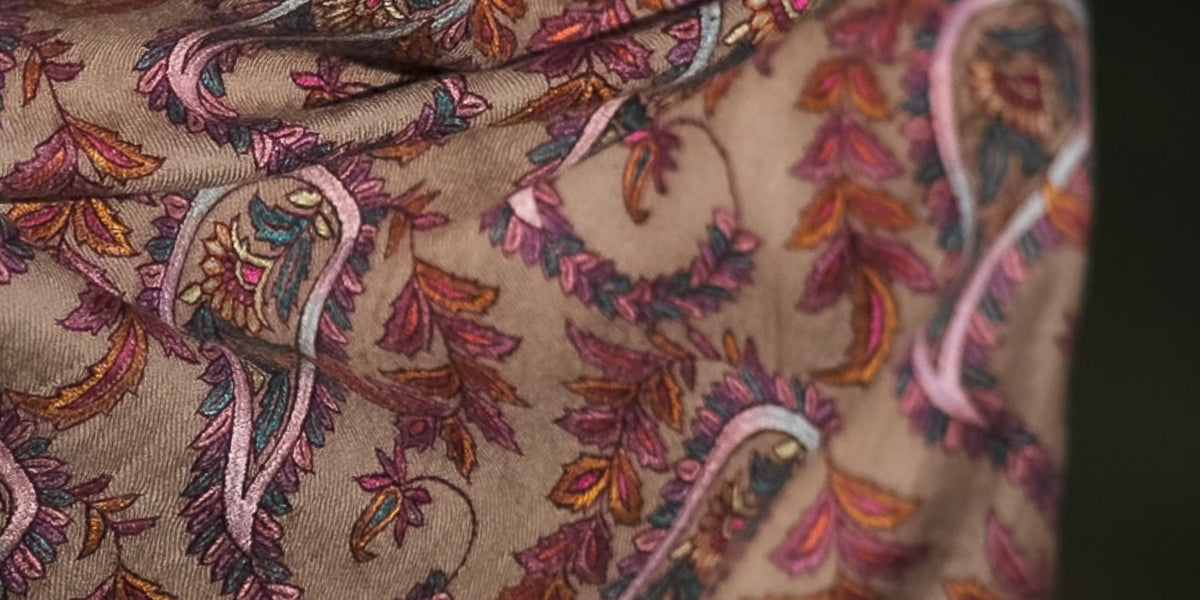
Cashmere's language is the plain luxury of knitwear. Pashmina's language is ornament: the Kani weave, built bobbin by bobbin from a coded talim script, and Sozni, the needlework tradition unique to Kashmir whose finest work leaves a back almost as clean as the front, with no loose threads, and whose signature stitch imitates the surface of woven Kani so closely that history records the two being confused. In its highest forms, do rukha work, the embroidery is finished on both faces so that the shawl has no wrong side at all. No mill anywhere produces this. It exists only where it was invented.
How Can You Judge the Authenticity Before You Order Pashmina?
You must raise a question on origin, and ask for a concrete answer: true Pashmina fibre is Ladakhi, true Pashmina craft is Kashmiri. Hold the yarn up to the light: hand spun thread shows tiny natural variations, a life that machine spun yarn cannot match. Turn the piece over: Kani shows its interlocked colour ridges, fine Sozni shows a disciplined back, prints show a pale ghost of the front. Feel the warmth to weight ratio: real Pashmina is warm out of all proportion to its featherweight. Distrust the burn test folklore and the ring test as proof; a fine loose weave of many fibres will pass a ring, and the only reliable guarantee is a maker who can tell you, truthfully and in detail, who spun and wove your shawl.
That, finally, is the difference that cannot be counterfeited: provenance. A house that has lived inside this craft, as ours has in Srinagar since 1881, does not need to argue with a label. It can simply show you the loom.
Frequently Asked Questions
Are Pashmina and cashmere the same fibre?
They name the same family of goat down, but not the same product. Cashmere is the global industrial term for fibre now sourced mainly from China and Mongolia and processed by machine. Kashmiri Pashmina is the fine Ladakhi fibre of the Changthangi goat, hand spun and handwoven in Kashmir by traditional methods.
Why is Kashmiri Pashmina more expensive than ordinary cashmere?
Because almost nothing in it is done by machine. Hand dehairing, hand spinning, handloom weaving, and hand embroidery multiply the human hours in every piece, and the fibre itself sits at the finest end of the international scale.
Is the ring test proof of real Pashmina?
No. If a shawl will pass through a ring, that only shows that it is light and loosely made; many mixtures will pass. Judge the fibre's origin, the character of the hand spun yarn, the reverse of the weave or embroidery and the credibility of the maker.
What should a real Pashmina shawl feel like?
Almost weightless, with a dry soft warmth that builds within moments of wearing. The surface shows the fine diagonal rib of twill, and the drape is fluid rather than limp or springy.
Does machine made pure Pashmina exist?
Cloth sold under that label often comes from power looms using synthetic reinforced yarn, with the synthetic dissolved out by acid afterwards. The process damages the fibre. Traditional hand weaving remains the only method true to the material.

Written by Veave Lore

Leave a comment
This site is protected by hCaptcha and the hCaptcha Privacy Policy and Terms of Service apply.